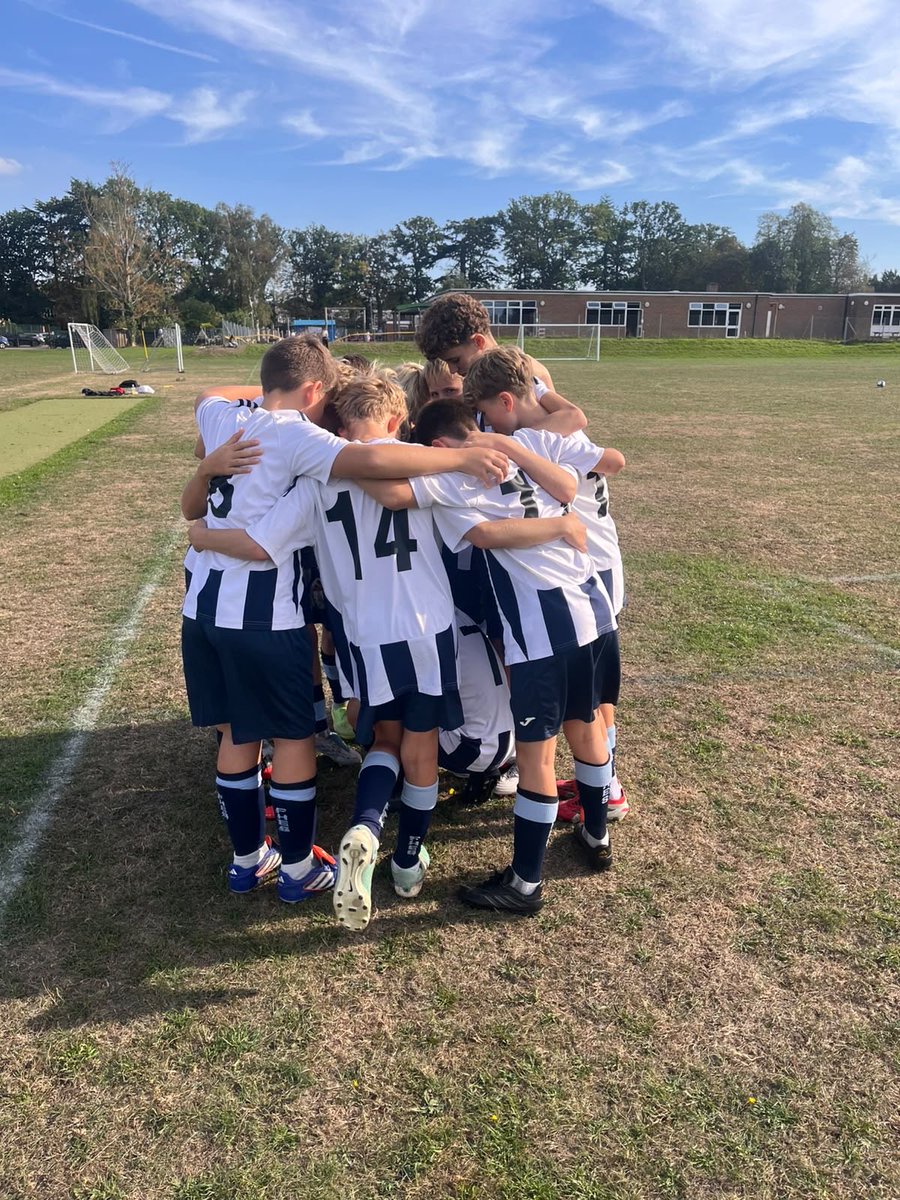
 @TeamFHES - 25/09/2026Congratulations to our Year 7 footballers who won 3-1 in the County Cup #TeamFHES
Subject Information - Maths
VISION / AIM
Our vision is to inspire the students to master mathematics by empowering students to have the confidence and resilience to take on a full range of mathematical problems.
This will be achieved through the consistent, effective delivery of the KS3 mastery curriculum which builds strong foundations for KS4 and beyond. Students are able to develop the confidence to apply their mathematical knowledge to a take on any mathematical problem they are tasked with. This includes, but is not limited to using algorithms, learning formulae and following rote routines.
As a department, we help students to understand the importance of Mathematics beyond their GCSEs and be able to apply their knowledge to real life, for example being confident and competent in becoming financially literate.
A range of KS4 programmes including Functional Skills, GCSE Statistics and Further Mathematics will enable the students to fulfil their potential in Mathematics across all levels of ability.
The curriculum is further supported through home learning being set on Sparx Maths each week. In year 11, during the autumn term, home learning is transitioned to exam paper based work in order to prepare students for their upcoming exams.
Homework support sessions are also available on Wednesdays after school.
Resources and support materials can be found on Google Classroom.
Further information can be requested from Mrs R Isaacs, Head of Department, risaacs@fhes.org.uk
CURRICULUM OVERVIEW
|
|
Autumn Term |
Spring Term |
Summer Term |
|
Year 7 |
|
|
|
|
Year 8 |
|
|
|
|
Year 9 |
|
|
|
|
Year 10 Higher Tier |
|
|
Autumn Term |
Simultaneous Equations |
|
Probability |
|
|
Multiplicative Reasoning and Proportion |
|
|
Quadratics and Inequalities |
|
|
Spring Term |
Histograms and Cumulative Frequency |
|
Bounds and Surds |
|
|
Summer Term |
Further Trigonometry and Bearings |
|
Similarity and Congruency |
|
|
Volume and Surface Area |
|
|
Quadratic Sequences, Parallel and Perpendicular Lines, Functions |
|
Year 11 Higher Tier |
|
|
Autumn Term |
Circle Theorems |
|
Algebraic Fractions and Iteration |
|
|
Spring Term |
Ratio including Ratio Changes |
|
Vectors |
|
|
Graphs |
|
|
Proof and Reasoning |
|
Year 10 Foundation Tier |
|
|
Autumn Term |
Linear Graphs and Real Life Graphs |
|
Multipicative Reasoning and Proportion |
|
|
Equations, Inequalities and Sequences |
|
|
Spring Term |
Data |
|
Indices, Powers, Roots Recap |
|
|
Pythagoras and Trigonometry |
|
|
Similarity and Congruency |
|
|
Summer Term |
Volume and Surface Area |
|
Number Recap - Fractions, Decimals, Percentages, Ratio, Standard Form |
|
Year 11 Foundation Tier |
|
|
Autumn Term |
Simultaneous Equations |
|
Probability |
|
|
Angles and Properties of Shapes |
|
|
Spring Term |
Quadratics and Non-Linear Graphs |
|
Transformations |
|
|
3D Representations, Loci |
KEY SKILLS
|
Key Skills |
Year 7 |
Year 8 |
Year 9 |
Year 10 |
Year 11 |
|
Problem Solving |
Able to start a question confidently. Progression throughout in Mathematical language. |
Trying an option without knowing a solution. |
|
|
Highest sophistication in problem solving. |
|
Fluency |
Able to speak in sentences. Confidence in use of calculator for arithmetic. |
Effective use of Mathematical equipment. |
|
To have the flexibility to move between different contexts. |
Multi-staged problem comprehended and interpreted. All effective functions for a calculator. |
|
Mathematical Thinking |
To identify patterns. To apply learning to a range of problems. Begin to explain misconceptions. |
To know whether an answer is mathematically sensible. |
To confidently articulate ideas and understanding. |
|
To communicate ideas using precise mathematical language. |
|
Variation |
Able to use multiple methods for key numeracy skills. |
To identify ‘if I change this, what will happen to this…..’ |
|
|
Multivariate analysis. |
|
Representation and Structure |
Apply the appropriate representations. |
To have the flexibility to move between different representations. |
Identify the most effective representations. |
|
|
GCSE MATHS EXAM BOARD
|
Exam Board |
EdExcel |
|
Paper 1 |
Non-Calculator topics as per specification. 80 marks, 90 minutes |
|
Paper 2 |
Calculator topics as per specification. 80 marks, 90 minutes |
|
Paper 3 |
Calculator topics as per specification. 80 marks, 90 minutes |
|
Link to the Specification |
https://qualifications.pearson.com/content/dam/pdf/GCSE/mathematics/2015/specification-and-sample-assesment/gcse-maths-2015-specification.pdf |